

Research background
Retatrutide: Mechanism & Published Research
Retatrutide (LY3437943) is a long-acting, once-weekly peptide agonist studied for its simultaneous activation of three metabolic receptors: the glucose-dependent insulinotropic polypeptide receptor (GIPR), the glucagon-like peptide-1 receptor (GLP-1R), and the glucagon receptor (GCGR). This triple-agonist profile distinguishes it from dual agonists such as tirzepatide and single-agonist GLP-1 drugs such as semaglutide.
In the published literature, researchers have examined retatrutide’s pharmacokinetic profile extensively. The compound exhibits a plasma half-life in the range of approximately five to seven days following subcutaneous administration, enabling once-weekly research protocols. This extended half-life is attributed to fatty acid side-chain conjugation that promotes albumin binding, a structural feature shared with other long-acting peptide analogs.
Dose-ranging studies published in peer-reviewed journals have evaluated administration amounts from 0.5 mg up to 12 mg per week in human research cohorts. Researchers studying energy homeostasis have reported that the glucagon receptor component may contribute to increased hepatic glucose output and energy expenditure modulation, effects not observed with GLP-1 mono-agonism alone. The GIP component is thought to potentiate insulin secretion in a glucose-dependent manner and may contribute to improved tolerability relative to GLP-1-only compounds.
Retatrutide has also attracted research interest in the context of non-alcoholic steatohepatitis (NASH) and cardiovascular metabolic disease, with investigators examining biomarkers including alanine aminotransferase, liver fat fraction by MRI-PDFF, and HOMA-IR. It is important to note that retatrutide remains an investigational compound and has not been approved by Health Canada or the FDA for any therapeutic indication. All research at Canada Peptide Supply is conducted under strict in-vitro or pre-clinical research protocols.
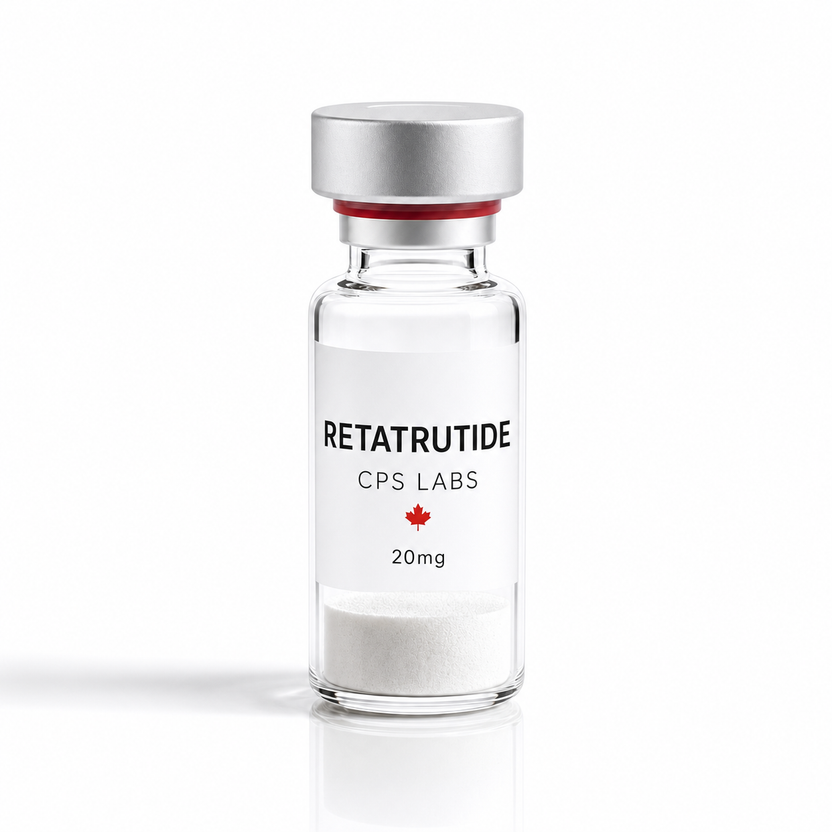
Our retatrutide is supplied as lyophilized powder, ≥99% HPLC-verified, with mass spectrometry identity confirmation on every batch. Researchers reconstitute using bacteriostatic water; storage is stable at -20 °C for 24 months or at 2-8 °C for up to 28 days post-reconstitution.
Research Use Only Disclaimer: All information on this page is provided for scientific reference purposes. Canada Peptide Supply does not provide medical advice. Retatrutide is sold strictly for in-vitro laboratory research by qualified investigators. It is not approved by Health Canada for human consumption, diagnosis, treatment, or prevention of disease.
