

Research background
Ipamorelin: Mechanism & Published Research
Ipamorelin is a synthetic pentapeptide growth hormone secretagogue (GHS) that acts as a selective agonist of the ghrelin receptor (GHS-R1a). It was developed to overcome some of the selectivity limitations of earlier growth hormone-releasing peptides (GHRPs), particularly the elevation of cortisol and prolactin observed with GHRP-2 and GHRP-6 in pre-clinical and early clinical models.
In the published pharmacology literature, ipamorelin has been characterized as a selective GHS-R1a agonist with an approximately 7,500-fold lower affinity for adrenocorticotropic hormone (ACTH) secretion and approximately 10,000-fold lower stimulatory effect on prolactin release compared to GHRP-2 at equimolar concentrations. This selectivity profile has made ipamorelin a preferred research tool in growth hormone axis studies where investigators wish to isolate GH secretion effects from corticotrophic side effects.
Pharmacokinetic studies in rodent and porcine models have characterized ipamorelin’s half-life at approximately two hours following subcutaneous or intravenous administration, making it suitable for pulsatile GH secretion research protocols. Researchers studying the somatotropic axis have used ipamorelin as a tool compound to examine GH pulse amplitude, IGF-1 downstream signaling, and GH-independent anabolic effects in various tissue models.
Ipamorelin is frequently studied in combination with growth hormone-releasing hormone analogs — particularly CJC-1295 (Mod GRF 1-29) — to produce synergistic GH pulse amplification in animal models. The combined GHRH + GHS approach has been examined extensively in the published growth hormone research literature as a means of more closely recapitulating the physiological GH secretory pattern.
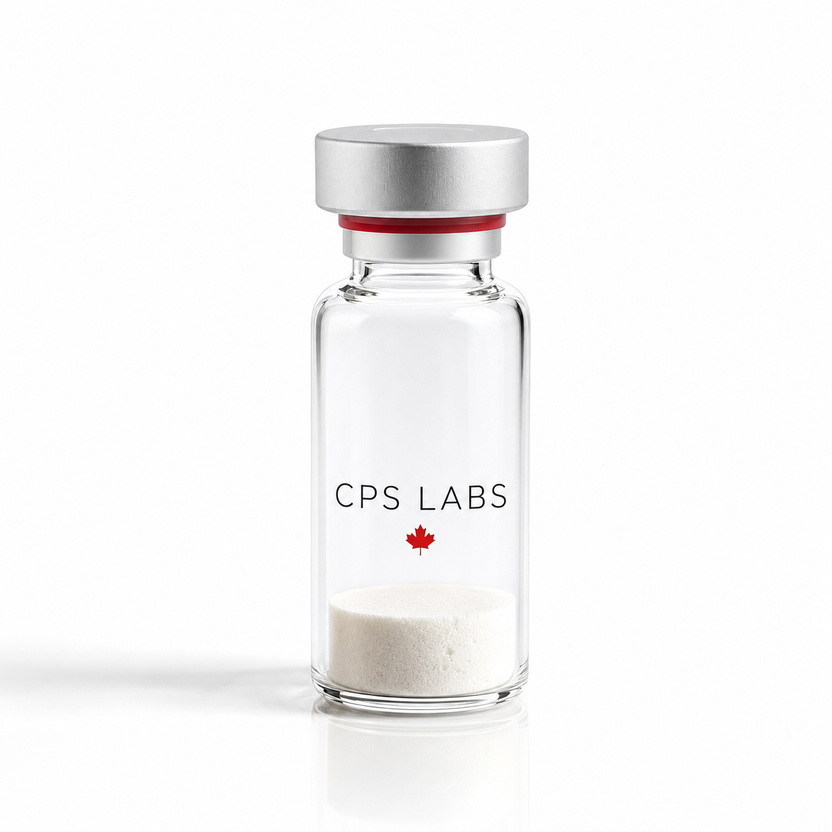
Canada Peptide Supply offers ipamorelin in 5 mg and 10 mg lyophilized vials, verified at ≥99% purity by HPLC and mass spectrometry. Ipamorelin is not approved by Health Canada for therapeutic use and is sold strictly for in-vitro laboratory research by qualified investigators.
Research Use Only Disclaimer: All information on this page is provided for scientific reference purposes. Canada Peptide Supply does not provide medical advice. Ipamorelin is sold strictly for in-vitro laboratory research by qualified investigators. It is not approved by Health Canada for human consumption, diagnosis, treatment, or prevention of disease.
